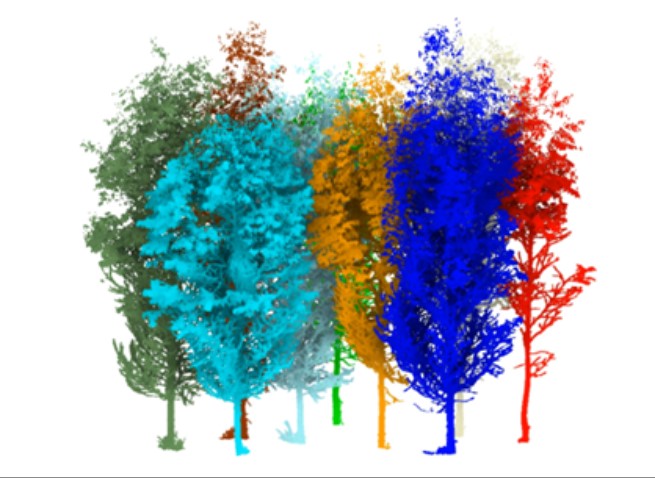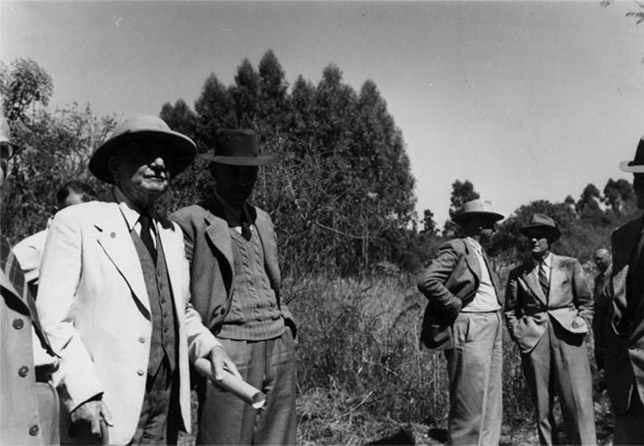

Understanding how trees grow and adapt to their surroundings is key to advancing sustainable forestry. During the 2025 Hans Merensky EucXylo Research Meeting, Oluwaseun Gakenou shared insights from his work using Terrestrial Laser Scanning (TLS) to study the structural variation among young Eucalyptus grandis trees grown in a common garden experiment. His presentation, titled “Lasers and Limbs,” showcased how high-resolution laser data can be used to reconstruct the three-dimensional architecture of trees and reveal how their growth forms differ across geographic provenances.
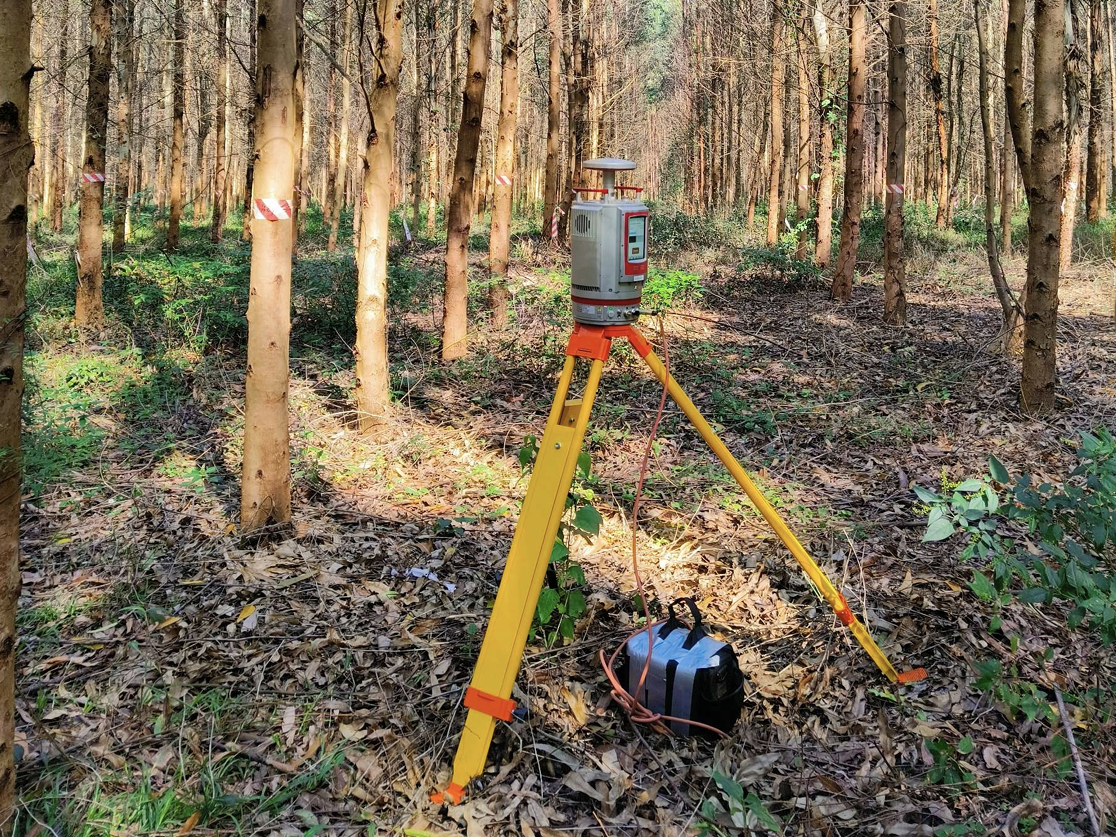
Using Terrestrial Laser Scanning (TLS), the team generated highly detailed 3D point clouds of Eucalyptus grandis trees, with spatial resolutions as fine as 1–5 centimeters. This method captures millions of laser reflections from every angle, effectively creating a precise digital replica of each tree. The “view from below” allows researchers to measure canopy structure, branch orientation, and trunk shape with remarkable accuracy, details that are nearly impossible to capture through traditional field measurements.
Statistical analyses (ANOVA) of these models revealed clear provenance-level differences, meaning that trees from different geographic origins show distinct structural traits. While trunk and crown size only showed a marginal effect of provenance (F = 2.00, p = 0.065), traits related to crown shape and branching arrangement differed significantly among provenances (p < 0.01).
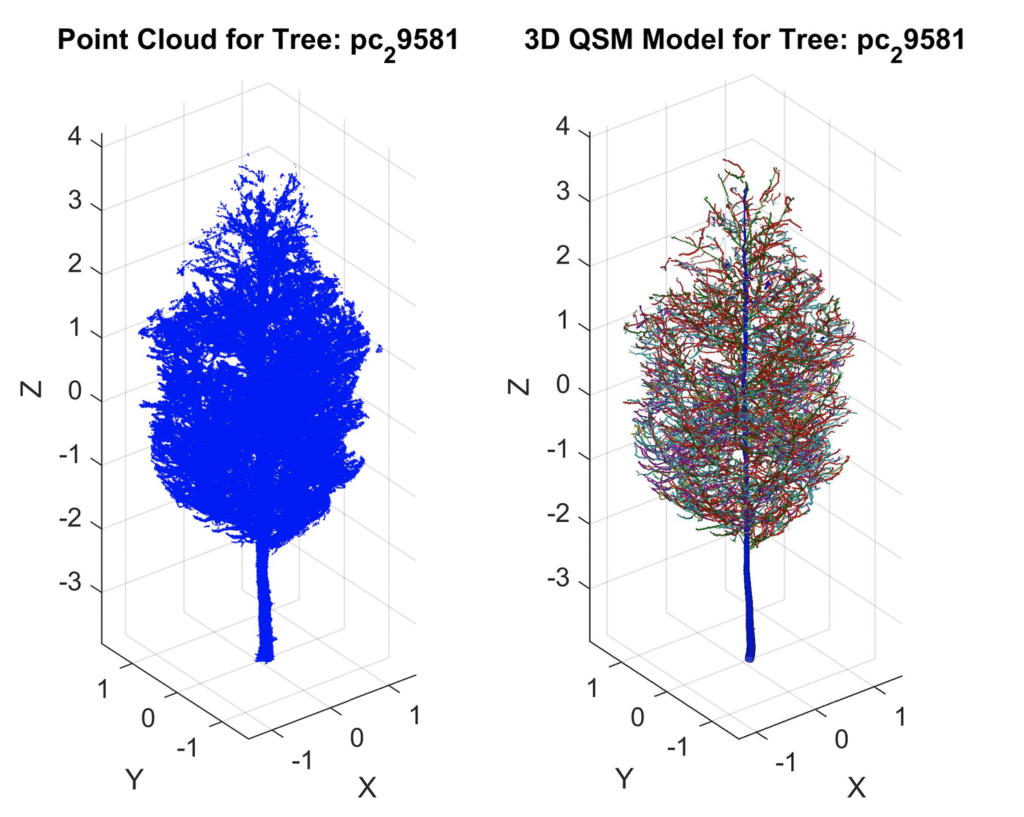
The next phase of this research involves completing segmentation and structural analysis across multiple years of scanning data to understand how tree structure evolves over time. By linking these patterns to competition and environmental factors, this work could help optimize breeding and management strategies for improved wood quality and resilience in commercial Eucalyptus plantations.
This research highlights how laser-based technologies are transforming forest science, allowing us to see, measure, and understand trees in three dimensions.
This study forms part of Oluwaseun’s current PhD research, titled Characterizing the spatiotemporal dynamics of crown architecture in young eucalypts using LiDAR technology, which investigates how crown structure and growth patterns change over time across multiple Eucalyptus species using terrestrial and airborne LiDAR systems.