
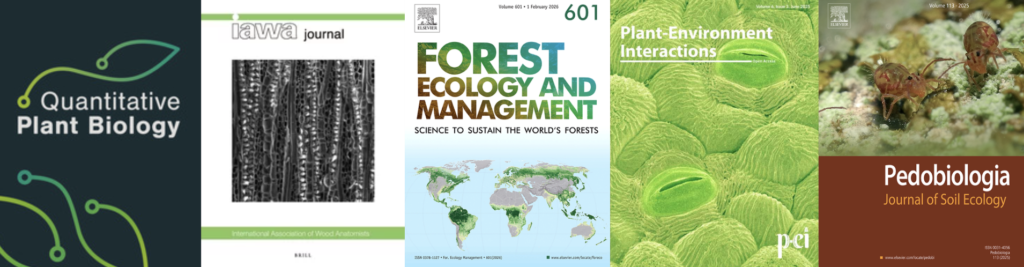
In 2025, EucXylo researchers, students, and alumni contributed to peer-reviewed publications across leading international journals. Together, these studies advance our understanding of Eucalyptus growth, wood formation, and drought resilience across multiple biological scales. Below are some of the publications of 2025.
UnderstandinPhysiological and morphological responses of Eucalyptus to drought
Singini, Eckert & Drew (2025) – Forest Ecology and Management
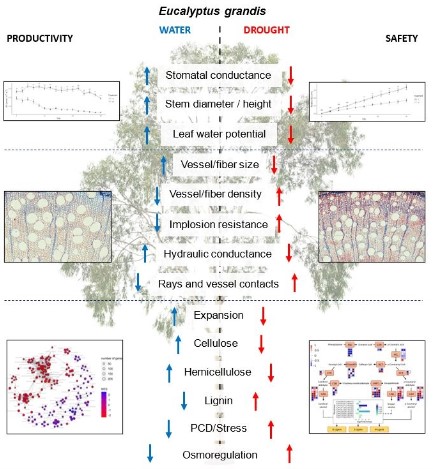
This systematic review and meta-analysis, by Dr Edith Singini and Dr Michelle Eckert, synthesises existing research on how Eucalyptus species respond to drought at both physiological and morphological levels. By identifying consistent response patterns across studies, the work provides an important foundation for future drought-resilience research and forest management strategies.
Soil feeding activity in Eucalyptus blocks
Eckert, Boulle, Pryke & Drew (2025) – Pedobiologia
In this study, Dr Michelle Eckert evaluated different bait materials used in the bait-lamina test to assess soil feeding activity in Eucalyptus systems. The research contributes to refining methodological approaches for measuring soil biological activity, an essential but often under-represented component of forest ecosystem functioning.
Wood formation under cyclical drought
Gama, Martin & Drew (2025) – Quantitative Plant Biology
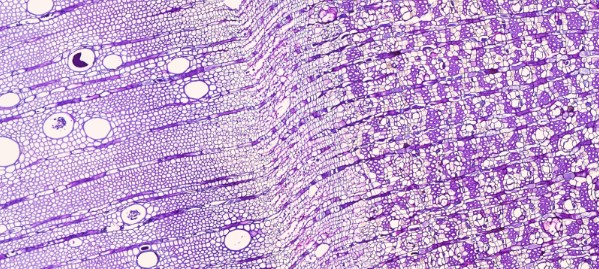
Gugu Gama, a doctoral candidate at EucXylo, investigated how the drought-resistant species Eucalyptus cladocalyx forms wood under cyclical drought conditions. Published as part of Advances in xylem and phloem formation research, this study provides quantitative insight into how drought-adapted trees maintain growth under repeated water stress.
Cavitation resistance mechanisms in Eucalyptus grandis
Keret, Hills & Drew (2025) – Plant–Environment Interactions
This publication, by Dr Rafael Keret, examines how xylem parenchyma anatomy and gene expression patterns contribute to cavitation resistance during drought.
3D microstructure of wood-forming tissues after drought
Schoeman & Drew (2025) – IAWA Journal
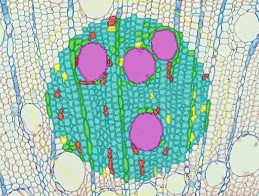
In this study, Dr Letitia Schoeman used high-resolution X-ray computed tomography to examine how previous drought exposure influences the three-dimensional microstructure of the cambium and developing xylem in Eucalyptus clones. The work reveals how drought history leaves lasting anatomical signatures in wood-forming tissues.